
Learning tarot
How to read the Marseille tarot: start with how the pips are arranged
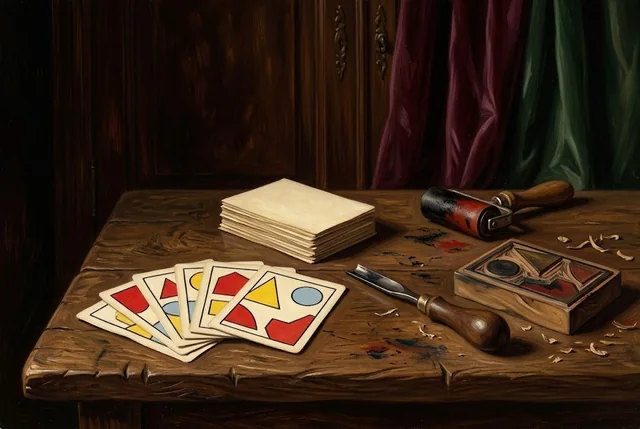
The first time most people see the Marseille minor cards, their reaction is: how am I supposed to read this?
Four cups in a row. Five staves crossed. No people, no story.
What kind of deck it is
In seventeenth and eighteenth-century France, card makers printed the outlines from woodblocks, then brushed on red, blue, yellow and green through stencils. Flat blocks of colour, thick lines.
Many of the Rider-Waite Major Arcana designs were adapted from here.
Three differences to remember first
- 8 and 11 are swapped: in the Marseille tarot, 8 is Justice and 11 is Strength. The Rider-Waite deck has them the other way round.
- Card 13 has no name: the card usually doesn't say "Death".
- The minor cards have no scenes: just numbers and suits.
Three things to look at in the minor cards
Number: the same as Rider-Waite. 1 is the beginning, 5 is imbalance, 10 is full.
Suit: batons are action, cups are feeling, swords are judgement, coins are tangible things.
Arrangement: this is the Marseille deck's own language. On the Two of Coins, a curving ribbon runs between the two coins, linking them like two matters that affect each other. The swords form a ring of curved blades; on odd numbers there's an extra straight sword in the middle, like a decision about to break through.
Make a sentence
Lay three cards in a row. Treat the first as the subject, the second as the verb and the third as the result.
The Emperor, the Hanged Man, the Three of Coins: someone who wants control is forced to stop and see things differently, and the result is a practical outcome that grows slowly.
Then look at which way the faces turn. Many Marseille figures are shown in profile, so you can treat the card a figure faces as a possibly related clue.
Why learn it
Without scenes, you pay more attention to lines, spacing and how the symbols are arranged. It's a different kind of observation practice.
When you go back to Rider-Waite, try looking for details you never noticed before.
The full five lessons and the French names of the 22 Major Arcana are in the tarot study room: Marseille series.
Common questions
If I learn Marseille after Rider-Waite, will I mix them up?
Should I use reversals with the Marseille tarot?
If you'd like to talk about your own situation, start with the readings on offer.