
Menu

Tarot study room · Spreads

Tarot spread diagrams

15 spreads, each drawn as a diagram with its positions labelled. Understand what each position asks before you draw.

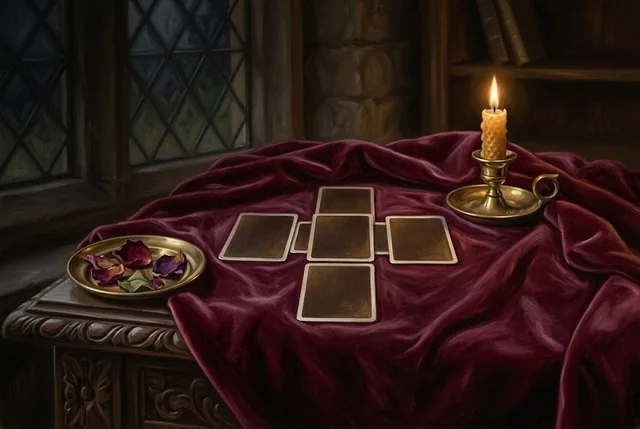
Five cards laid out in a cross on wine-red velvet, with a candlestick
  1. 1 card
  2. 3 cards
  3. 5 cards
  4. 7 cards
  5. 10 cards
  6. 13 cards

A suggested path: start with one card and add more once you're comfortable. More cards doesn't mean more accurate.

Beginner5 spreads

  1. 1Today's message

Daily card1 cardBeginner

Draw one card a day. Look at the picture and note your own thoughts before reading the meaning. You can look back in the evening too, and note what didn't fit.

  1. Today's message: what does this card remind you to watch for today?
  1. 1Past
  2. 2Present
  3. 3Future

The flow of time3 cardsBeginner

Divide the question into past, present and future.

  1. Past: the roots and influences that shaped the present
  2. Present: the current situation
  3. Future: where things are heading if they carry on as they are
  1. 1Body
  2. 2Mind
  3. 3Spirit

Body · mind · spirit3 cardsBeginner

Think about it from three angles: everyday needs, feelings, and what you care about. Not for judging health.

  1. Body: your physical and material state
  2. Mind: your emotional state and relationships with people
  3. Spirit: messages about inner growth
  1. 1Situation
  2. 2Action
  3. 3Outcome

Situation · action · outcome3 cardsBeginner

Look at the situation first, then what you could do, and finally how things might develop.

  1. Situation: the nature of the matter and where it stands
  2. Action: an attitude or approach to consider
  3. Outcome: how things might develop if you act
  1. 1Where it's stuck
  2. 2How to loosen it
  3. 3The first step

Three cards for being stuck3 cardsBeginner

For when things have stalled and you can't say why. Try reading the third card as something you can actually do.

  1. Where it's stuck: what exactly won't move
  2. How to loosen it: what other angle you could take
  3. The first step: something you could do tomorrow

Intermediate8 spreads

  1. 1Where you are
  2. 2How A develops
  3. 3How B develops
  4. 4A word on A
  5. 5A word on B

Either-or decision5 cardsIntermediate

Look at the possible development and cautions for options A and B separately, then compare them against the real conditions.

  1. Where you are: your current situation as you face the choice
  2. How A develops: where things may go if you choose A
  3. How B develops: where things may go if you choose B
  4. A word on A: what to watch for if you choose A
  5. A word on B: what to watch for if you choose B
  1. 1My state
  2. 2Their state
  3. 3The relationship as I see it
  4. 4The relationship as they see it
  5. 5The relationship's lesson
  6. 6Where it's heading

Mirror of the relationship6 cardsIntermediate

For talking about how two people get along. The cards can't prove what the other person thinks; questions still need talking through.

  1. My state: your position and mindset in the relationship
  2. Their state: the other person's position and mindset in the relationship
  3. The relationship as I see it: how you see this relationship
  4. The relationship as they see it: how the other person sees it
  5. The relationship's lesson: the challenge to face right now
  6. Where it's heading: where this relationship is going
  1. 1Mon
  2. 2Tue
  3. 3Wed
  4. 4Thu
  5. 5Fri
  6. 6Sat
  7. 7Sun

The week's flow7 cardsIntermediate

Draw one card for each day of the week, note your reading, and at the weekend see what fit and what didn't.

  1. Monday
  2. Tuesday
  3. Wednesday
  4. Thursday
  5. Friday
  6. Saturday
  7. Sunday
  1. 1Past
  2. 2Present
  3. 3Future
  4. 4Advice
  5. 5Surroundings
  6. 6Obstacle
  7. 7Outcome

Horseshoe spread7 cardsIntermediate

Seven cards to look in turn at background, recent events, surroundings and possible approaches.

  1. Past: the background to the matter
  2. Present: where things are now
  3. Future: developments in the near term
  4. Advice: an approach to consider
  5. Surroundings: the people and atmosphere around you
  6. Obstacle: the resistance to overcome
  7. Outcome: the likely overall ending
  1. 1The wish itself
  2. 2Inner help
  3. 3Outer help
  4. 4Inner resistance
  5. 5Outer resistance
  6. 6Action needed
  7. 7Likely outcome

Seven-pointed star wish spread7 cardsIntermediate

Break a goal apart and look at what you already have, possible help, difficulties and approaches.

  1. The wish itself: what this wish really means to you
  2. Inner help: qualities and abilities you have
  3. Outer help: support from your surroundings and the people who help you
  4. Inner resistance: hurdles in your mindset to get past
  5. Outer resistance: practical obstacles to deal with
  6. Action needed: what you could do first
  7. Likely outcome: how things develop if you go this way
  1. 1Spirit
  2. 2Water
  3. 3Fire
  4. 4Earth
  5. 5Air

The pentagram's five points5 cardsIntermediate

The studio's signature spread. The five points correspond to five elements, and the top card is what this matter is really asking.

  1. Spirit: what this is really asking
  2. Water: how you feel
  3. Fire: what you want to do
  4. Earth: the practical conditions
  5. Air: how you think
  1. 1Current job
  2. 2What I want
  3. 3What I have
  4. 4What's stuck
  5. 5Next step

Work cross5 cardsIntermediate

For wanting to change jobs, wanting a raise, or being stuck on a project.

  1. Current job: where things stand
  2. What I want: what you really want to get
  3. What I have: abilities and resources
  4. What's stuck: what's in the way
  5. Next step: what you could do first
  1. 1Me
  2. 2Them
  3. 3Between us
  4. 4What I can do
  5. 5What they need

A bridge between two people5 cardsIntermediate

Works for partners, family or colleagues. The two ends are the two people, and the middle is the road you share.

  1. Me: my state in this relationship
  2. Them: the other person's possible state
  3. Between us: what the relationship looks like now
  4. What I can do: what I can adjust on my side
  5. What they need: what the other person may be missing

More involved2 spreads

  1. 1The present
  2. 2Challenge
  3. 3Foundation
  4. 4Past
  5. 5The goal
  6. 6Future
  7. 7You
  8. 8Surroundings
  9. 9Hopes and fears
  10. 10Outcome

Celtic Cross10 cardsMore involved

Ten positions on one question. With more cards, first be clear on what each position means.

  1. Present: the core atmosphere of the question
  2. Challenge: the help or hindrance lying across your path
  3. Foundation: the deep root of the matter (below)
  4. Past: influences on their way out (left)
  5. Goal: conscious hopes (above)
  6. Future: influences about to arrive (right)
  7. Self: your attitude and state of mind
  8. Surroundings: the influence of others and your environment
  9. Hopes and fears: deep hopes or worries
  10. Outcome: the likely ending overall
  1. 1Theme of the year
  2. 2Month 1
  3. 3Month 2
  4. 4Month 3
  5. 5Month 4
  6. 6Month 5
  7. 7Month 6
  8. 8Month 7
  9. 9Month 8
  10. 10Month 9
  11. 11Month 10
  12. 12Month 11
  13. 13Month 12

Year-ahead spread13 cardsMore involved

Settle the starting month first. The first card is the theme of the year, and the other twelve each match a month.

  1. Theme of the year: the main direction to discuss this year
  2. Month 1
  3. Month 2
  4. Month 3
  5. Month 4
  6. Month 5
  7. Month 6
  8. Month 7
  9. Month 8
  10. Month 9
  11. Month 10
  12. Month 11
  13. Month 12

A week of spread practice

Ask a different way each day. After seven days, you'll know what you ask about most.

  1. Mon1 cardThis week's theme

    Draw one card and put it somewhere you'll see it.

  2. Tue2 cardsWant / need

    Two side by side. Are they different?

  3. Wed3 cardsThree cards for being stuck

    Pick the thing you're most stuck on this week.

  4. Thu1 cardA message for someone

    Draw for someone you care about. They don't need to know.

  5. Fri3 cardsStart / continue / stop

    Three things for next week.

  6. Sat5 cardsThe pentagram's five points

    More time at the weekend, so use a bigger spread.

  7. Sun1 cardReview

    Lay out the week's cards and draw one more as a summary.

To design your own spread, see course unit VI. More ideas in A different spread each day.